
An 8-station premade pouch packing machine can pick up a finished pouch, open it, receive a measured dose and seal it. That description leaves out the decisions that determine whether it will run your actual products. The rotary unit does not measure powder or granules by itself. It depends on a matched filler, a reliable product feed, suitable pouch handling and enough space in the cycle for any extra operations.
This matters most when one line will pack several dry products. A free-flowing grain and a dusty baking mix may use the same outer pouch machine but need different dosing, dust control and cleaning steps. A zipper pouch may need its closure opened before filling. A soft pouch may be harder to pick up than a stiff printed sample of the same nominal size. Define these jobs before comparing machine models or quoted speeds.
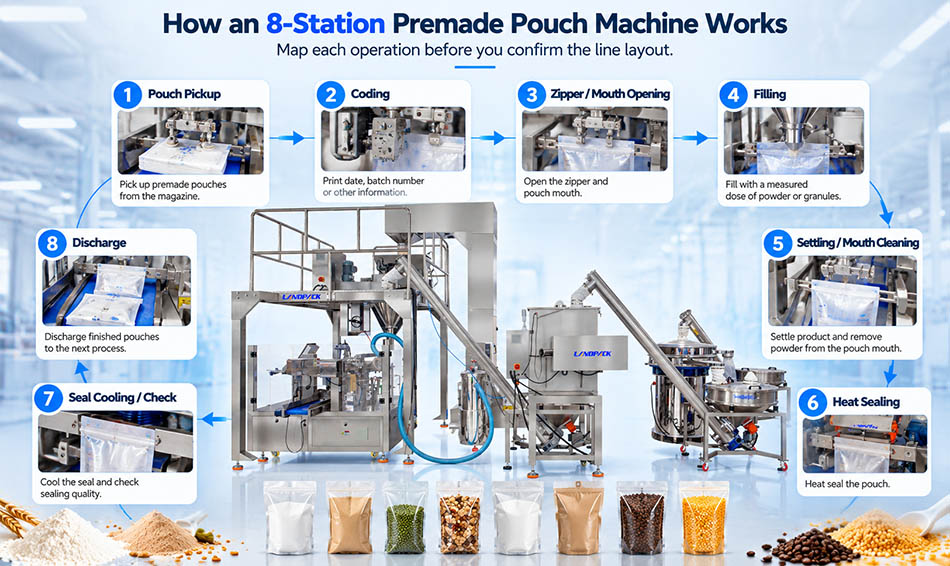
An eight-station rotary premade pouch packing machine indexes a premade pouch through a series of positions. A typical sequence may include pouch pickup, coding, zipper and mouth opening, filling, settling or mouth cleaning, heat sealing and discharge. The exact allocation varies with the equipment fitted. Some operations can be combined; others need a dedicated position or an external unit.
Ask for a station-by-station drawing of the proposed machine. It should show when the pouch is held open, where each product enters, when loose powder is cleared from the seal area, and which sealing operation follows. If a recipe needs two separate ingredients, a zipper opener, tapping and a cleaning device, the supplier must show how these fit into one cycle. The label “eight station” alone does not answer that question.
For mixed products, decide whether ingredients are blended before packing or dosed into the same pouch in sequence. Pre-blending simplifies the filling path but may not suit a recipe whose particles segregate during transfer. Sequential dosing keeps the components separate until they reach the pouch, but the filler outlets and timing need to be coordinated. Run the proposed recipe during testing rather than accepting separate demonstrations of the two fillers.
Start with physical pouch samples and a list of every format expected in production. Record width, length, bottom gusset, zipper style, film structure, empty-pouch stiffness, target fill weight and how often each format runs. Include the smallest and largest pouch, but give special attention to the sizes that account for most of the work.
A machine’s published width range may span several frame sizes. It does not mean one frame handles every pouch in the catalogue, or that every size changes by touchscreen alone. The grippers, pouch magazine, opening device, filling funnel and seal jaws must all suit the selected range. At the edge of that range, manual adjustments or different tooling may still be needed.
Pouch behavior matters as much as dimensions. Thin, flexible bags can sag as the gripper presents them to the opening device. Zipper tracks can remain partly closed; a bottom gusset may not expand fully. Send samples made from the production material, including the most flexible and the most difficult zipper format. Ask the supplier to show repeated pickup, opening and filling, not a single successful cycle.
If one unusual pouch needs different handling hardware, identify that exception early. It may require a change part, a separate setup or another machine. Do not select an oversized frame for a rare large pouch without checking what that choice does to the smaller pouches packed every day.
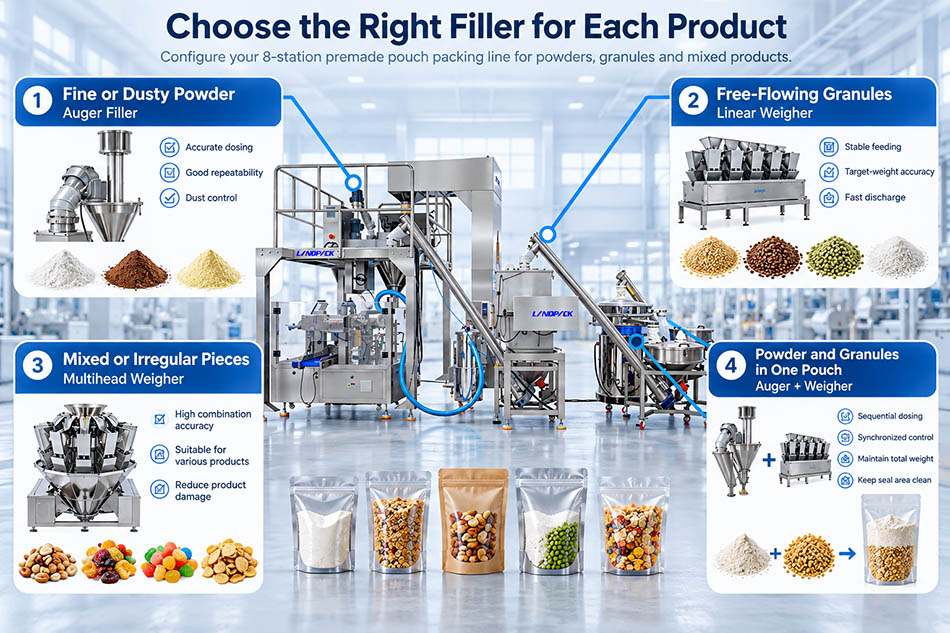
The filler should match how the product moves and the weight that must enter each pouch. The rotary packer holds and transports the bag; the filler meters its contents.
| Product Behavior | Common Dosing Approach | What to Verify in a Trial |
|---|---|---|
| Fine or dusty powder | Auger filler | Dose repeatability, powder left at the nozzle, dust at the pouch mouth |
| Free-flowing grains or small granules | Linear weigher | Stable feed, target-weight variation, discharge time |
| Mixed or irregular pieces | Multihead weigher, where appropriate | Combination accuracy, product damage, drop into the pouch |
| Powder and granules in one pouch | Auger plus weigher, or a validated pre-blend | Dose order, synchronization, total weight and seal cleanliness |
A linear weigher can be a sensible choice for products that feed consistently at the required rate. A multihead weigher offers another route when combination speed or a wider product mix justifies it. Neither choice should be made from a product name alone. Particle size, stickiness, fragility, bulk density and target weight all affect the result.
For powders, the auger size and its operating range deserve their own review. One screw that performs well at a large dose may be a poor choice for a much smaller pack. Ask which screws, hoppers and nozzles are included for each weight band, how they are changed, and whether a shutoff device limits dribble after dosing. The stated accuracy should be demonstrated with your actual powder over a meaningful run.
If an in-line checkweigher is part of the proposal, confirm what its signal does. It may only identify and reject an out-of-range pouch. Automatic feedback to the auger is a separate control function and should be specified explicitly if required.
“Quick changeover” can mean several different things: changing a pouch recipe, moving grippers, replacing an auger, cleaning the powder path or swapping a weigher. Those jobs take different amounts of time. A line alternating between sugar and a dusty flour blend may spend more time cleaning than adjusting the bag width.
Ask the supplier to document one complete change from the product most often packed to the next most common product. The sequence should cover stopping and emptying the feed path, removing contact parts, cleaning, installing the next filler or screw, selecting settings, running first-off pouches and checking weight and seals. Record who performs each step and which tools are needed.
For a line with both an auger filler and a weigher, specify whether both remain installed, move on a platform, or must be mechanically replaced. If both dispense into one pouch, confirm the dosing order and how a missed dose stops that pouch from being sealed as a saleable pack. A layout drawing should show the operator’s access to each unit, not just the rotary machine footprint.
Powder packaging often fails at the top of the pouch, even when the measured dose is correct. A cloud released during filling can settle on the sealing surface. Product can also cling to the funnel or fall after the auger stops. If powder remains between the seal layers, changing the jaw temperature alone may not solve the problem.
Review the whole path: how powder leaves the supply hopper, how it enters the auger, where displaced air goes during dosing, and how the pouch mouth is cleaned before sealing. Depending on the product, a proposal may include local extraction, a controlled filling funnel, pouch tapping or a mouth-cleaning step. Each has a specific job. A dust collector near the filler does not automatically remove powder already sitting on the seal area.
Ask for test pouches at both small and large doses. Inspect seal appearance and integrity after the machine has run long enough for dust to accumulate. If the product is particularly dusty, test a stop-and-restart as well. The restart pouch often exposes material left in a nozzle or funnel.
Cleaning claims need similar precision. “Washable” may refer to removable product-contact parts rather than the motors, sensors, electrical cabinet and elevator. Define which components can be rinsed, which must be dry cleaned, how they are removed, and how the system is dried before the next powder. Request written cleaning instructions for the exact supplied configuration.
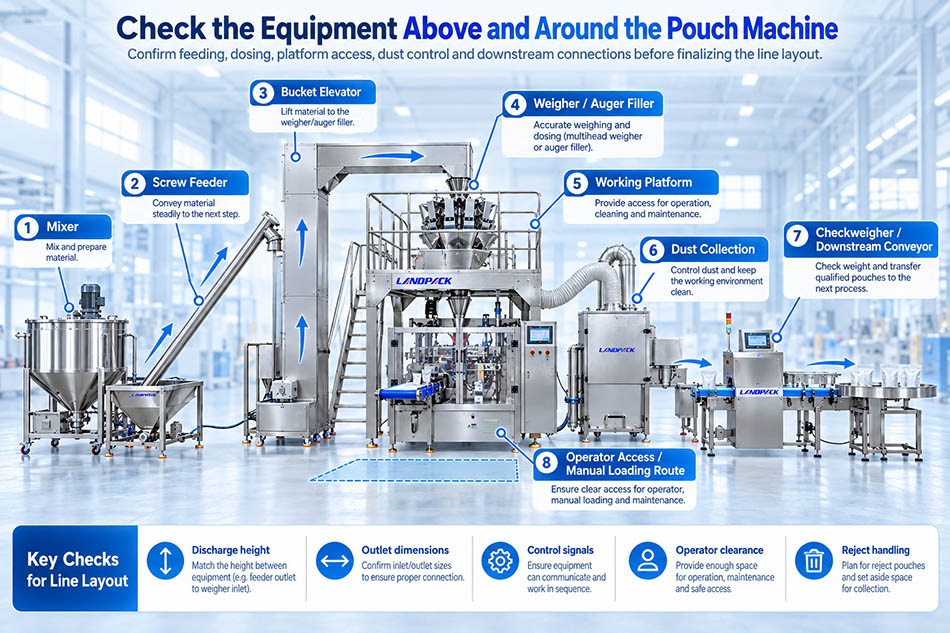
The rotary packer is only one part of the line. A blender, screw conveyor, bucket elevator, weigher, work platform and dust extraction system may determine the final footprint and operating height. If existing equipment will feed the line, provide its discharge height, outlet dimensions, control signals and a dimensioned floor plan.
Pay particular attention to the connection between a mixer and screw feeder. A poorly matched inlet can leave product behind or release dust during transfer. The feeder must also supply the dosing unit consistently enough to avoid starving it mid-cycle. For manual charging, show the operator’s route to the platform, handrails, working clearance and the space needed to lift bags safely.
Keep optional equipment tied to a defined problem. A checkweigher can help identify packs outside a weight limit; it does not correct the filler unless feedback is designed into the controls. A coder must match the print area and variable data required on the pouch. Additional inspection devices should have a clear reject location and a recovery procedure.
Catalogue speed is a machine reference, not a promise for every pouch and recipe. A large powder dose may need more dispensing and settling time than a small granular dose. A flexible pouch may take longer to open reliably. Extra cleaning or a second fill can also occupy cycle time.
Ask for a target expressed as saleable pouches per minute for named products and pouch formats. The supplier should state the test conditions: dose, pouch material, zipper or gusset, filler, seal settings and run duration. Compare the output of the auger, weigher, upstream feed and rotary unit. A faster index rate does not help if the filler cannot complete its dose before the pouch moves.
For frequent product changes, estimate weekly output rather than relying only on the best uninterrupted speed. Include the time to clean, replace dosing parts, verify the first packs and replenish pouches. This gives buyers a more useful basis for comparing a flexible line with a faster but less adaptable configuration.
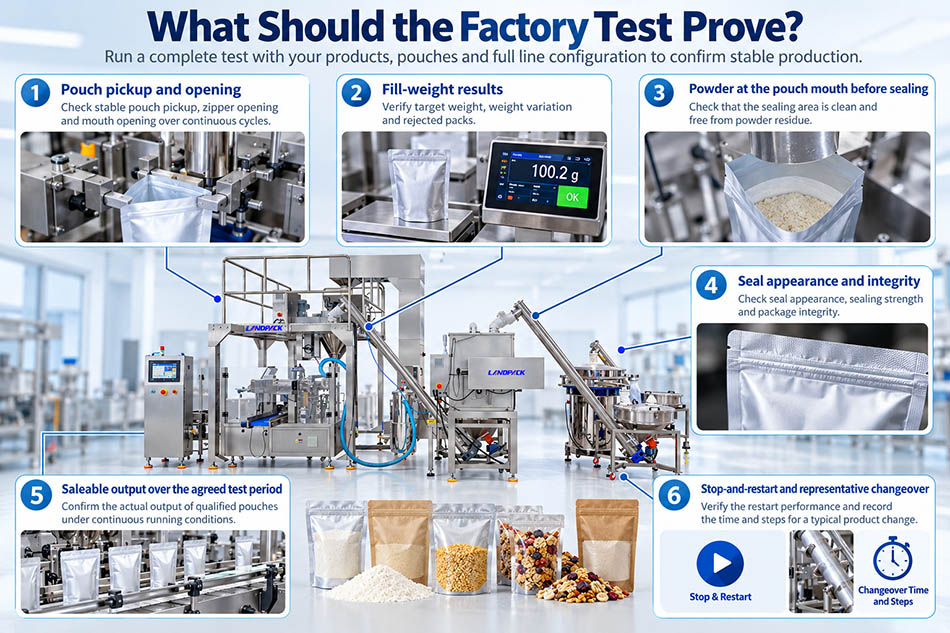
Before approving shipment, agree on a test matrix. It should include a routine powder, a routine granule, the smallest and largest planned pouches, and any soft or zipper pouch that is hard to open. If two ingredients will share a pouch, test that complete recipe. Use production-like materials and document any substitute used during the trial.
For each run, record:
1. Pouch pickup and opening failures
2. Filled-weight results and rejected packs
3. Powder remaining at the mouth before sealing
4. Seal appearance and integrity
5. Actual saleable output over the agreed test period
6. Stop-and-restart behavior
7. Time and steps required for a representative changeover
Test the connected line, not only the rotary base. Check the mixer or feed equipment, filler signals, coder, checkweigher and reject handling against the approved drawing. Ask for operating instructions, settings, spare-part lists and the agreed installation plan. Equipment shipped in separate sections must still fit and communicate after it is reassembled on site.
Send these details with your request for quotation:
1. Product samples or a clear description of each powder and granule, including flow behavior and any dust problem.
2. A pouch matrix with drawings, physical samples, zipper or gusset details, and expected production share by size.
3. Fill weights for every recipe, including the smallest dose and the largest dose that must run on the same line.
4. Whether powder and granules run separately, are blended first, or enter one pouch in two steps.
5. Required saleable output for each representative recipe, plus expected changeover frequency.
6. Existing mixers, conveyors and inspection equipment to be reused, with dimensions and interface details.
7. Cleaning method, coding content, weight-checking logic and acceptance tests.
An eight-station rotary premade pouch system for powder and granule mixing is one example of a line that combines a weigher, auger dosing and separate pouch-handling steps. Its published configuration shows the equipment types available, but the final station allocation, bag range and output still need to be checked against the buyer’s own products and pouches.
Specify an 8-station premade pouch packing machine from the pouch and product outward. First prove that the selected frame picks up and opens the full set of production bags. Then match each product to its dosing equipment, show how every required operation fits into the rotary cycle, and test the complete feed-to-seal path.
A quotation becomes useful when it states what will be changed between recipes and what the factory test must demonstrate.


Copyright © Foshan Land Packaging Machinery Co., Ltd. All Rights Reserved | Sitemap