
Table of Contents
A carton erector looks simple from the outside. It takes a flat corrugated carton, opens it, folds the bottom flaps and prepares the box for sealing or loading.
The buying decision is less simple.
Two cartons can have similar outside dimensions but behave differently on the same machine. A packaging line can also run into problems at the connection between the carton erector and the next conveyor even when both machines work correctly on their own.
From Landpack's experience with carton erecting and complete case packing systems, many specification problems start before machine production: incomplete carton dimensions, unclear conveyor interfaces, missing utility information or no real carton samples for testing.
Before choosing a carton erector, check whether it can form your actual cartons and transfer them to the next machine at the speed your line needs.
Before ordering a carton erector machine, confirm the carton, factory utilities, downstream connection and test conditions together.
The following eight checks cover the points that matter most during machine selection and installation.
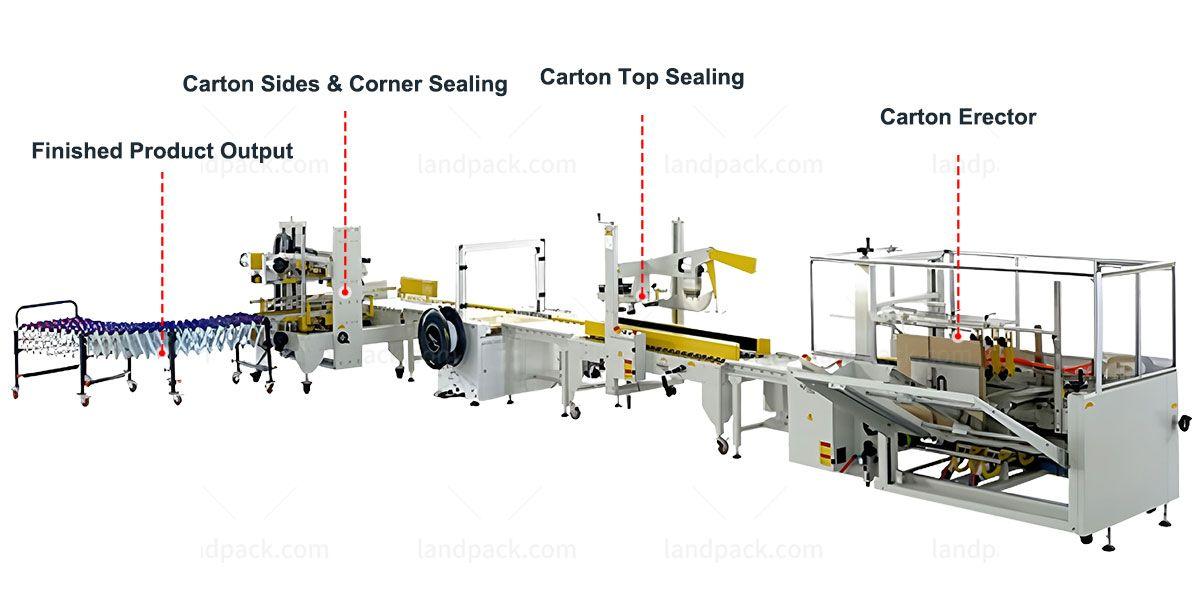
Carton erecting and downstream sealing on a Landpack line.
The first question should not be, "What is your fastest model?"
Start with the cartons.
Prepare the minimum, most common and maximum carton sizes you expect to run. For each carton, record:
· Length
· Width
· Height
· Corrugated board type
· Board thickness
· Flap dimensions
· Tape requirement
· Carton opening direction
Do not judge compatibility from one dimension alone.
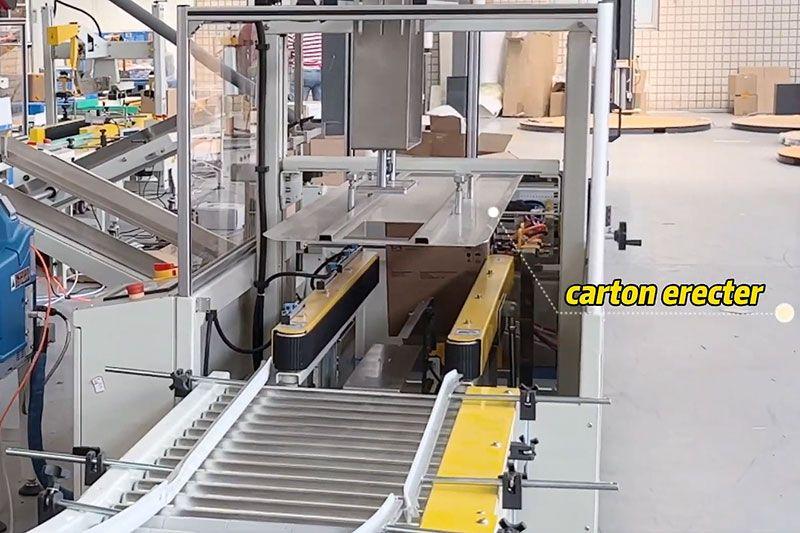
Check how the erector opens the actual corrugated case, not just the stated size range.
A carton erector has a working range, but the minimum and maximum values in a specification table do not always work in every possible combination.
For example, a long carton with a low height may sit inside the stated L × W × H range while still requiring a different adjustment range or machine structure.
If your factory uses several carton formats, send the full size list before the supplier confirms the machine model.
Landpack normally evaluates carton dimensions together with the intended production layout instead of selecting an automatic carton erector from carton size alone.
That matters when the machine will later connect with a case packer, carton sealer or palletizing section.
Drawings are useful. Real cartons tell you more.
Corrugated cartons vary in stiffness, folding memory, surface condition and manufacturing tolerance. Storage conditions can also change how easily a flat carton opens.
For a new automatic carton erector project, provide physical samples of the smallest, normal and largest cartons whenever possible.
A sample test can expose problems that a size table cannot:
· The carton does not open squarely
· Suction cups lose grip
· Bottom flaps interfere during folding
· The carton twists after opening
· Tape position shifts
· A carton size needs a guide or suction adjustment
· The blank orientation does not match the feeding direction
If you use cartons from several suppliers, tell the machine manufacturer. Small differences in carton construction can affect pickup and forming.
Do not wait until shipment to discover them.
At Landpack, actual carton samples can also help determine whether an existing machine configuration is suitable or whether guides, suction positions or transfer sections need adjustment before production.
A carton erector only needs to keep pace with the equipment that follows it.
For example, if the case packer runs at 8 cases/min, using a carton erector rated at 30 cases/min will not make the whole line run at 30 cases/min.
The actual line speed still depends on the slowest process. To increase total output, you need to address that bottleneck or add enough accumulation between the machines.
Ask three separate questions:
1. What is the rated carton erecting speed?
2. What speed can the machine maintain with my actual cartons?
3. What speed does the complete packaging line need?
Also check carton magazine capacity and size-change time.
An operator may need to refill cartons frequently. Production may also run several carton sizes during one shift. Both affect real daily output.
For an end of line packaging system, line balance matters more than the highest number printed in one machine specification.
This becomes more important when the carton erector connects to a Landpack case packing system with carton packing, sealing, weighing, labeling or palletizing equipment.
The correct target is the required line output, not the maximum speed of one standalone machine.
"220V" is not a complete electrical specification.
Before machine production starts, confirm:
· Voltage
· Frequency: 50Hz or 60Hz
· Single-phase or three-phase
· Plug or wiring requirements
· Compressed-air pressure
· Air consumption
· Whether your factory already has a suitable air compressor
A case erector machine normally combines motors, sensors, solenoid valves, vacuum components and pneumatic cylinders. Its electrical and pneumatic configuration must match the installation site.
Do not leave these questions until the machine reaches your factory.
A clear utility list also lets the maintenance team prepare cables, breakers, air lines and connection points before installation.
For a complete line, send the same utility information for all connected machines. This makes it easier to check the total electrical load and compressed-air requirement before installation.
This point causes more trouble than many buyers expect.
A machine can open cartons correctly but still create problems when the erected cartons move to a conveyor, manual packing station, automatic case packer or carton sealer.
Confirm:
· Carton erector discharge height
· Downstream conveyor height
· Conveyor width
· Conveyor direction
· Distance between machines
· Carton transfer direction
· Available floor space
· Required carton orientation at the next machine
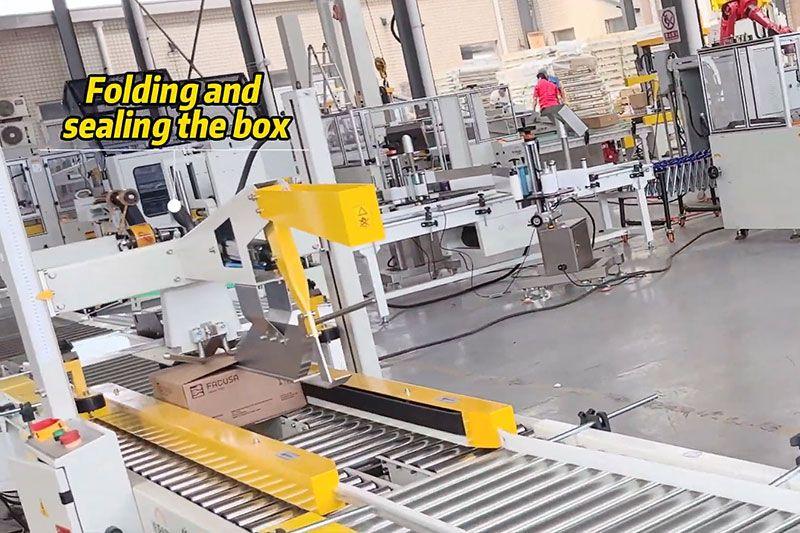
Look at the case position and conveyor handoff after folding and sealing.
Use a dimensioned layout instead of relying only on photos or videos.
If you plan to keep an existing conveyor, measure its connection point carefully.
A height or position mismatch may require extra conveyor sections, new guide rails or mechanical modification during installation.
Landpack usually treats these transfer dimensions as part of the complete case packing system layout rather than checking each machine independently.
That approach becomes particularly useful when a project includes an existing customer conveyor or equipment from another manufacturer.
The transfer point belongs in the machine specification. It should not become a problem that the installation team has to solve after delivery.
"Carton erector" does not always describe exactly the same machine configuration.
Before comparing quotations, define the required process:
· Open the flat carton only
· Open and fold the bottom flaps
· Open, fold and tape the bottom
· Open, fold and hot-melt seal the bottom
· Feed the erected carton directly to a case packer
If you use adhesive tape, specify the tape width and carton material.
If the erector connects to an automatic case packing machine, also confirm the required carton orientation at discharge.
Does the next machine need the carton long-side first or short-side first?
This sounds like a small detail until two machines arrive with incompatible transfer directions.
Define the process before comparing prices. Otherwise, two quotations may look similar while covering different functions.
When choosing a Landpack carton erecting system, buyers should firstly decide whether they only need a standalone erector or a complete setup that includes carton erecting, case packing and carton sealing.
Planning the full line at the beginning can reduce the amount of modification needed later when the erector connects with other packaging equipment.
A short video of an empty machine does not tell you enough.
Before shipment, ask the supplier to test the carton erector with the approved carton samples and show the complete cycle:
Machine demonstration: carton erecting, sealing and case transfer.
Watch the Landpack carton erector line video
Video shows a machine configuration. For acceptance testing, request a run with your own carton sizes and record the carton transfer at the next station.
Carton pickup → Opening → Bottom flap folding → Bottom sealing → Discharge
If the machine will run several carton sizes, test more than one.
Pay attention to:
· Whether the carton opens square
· Whether suction pickup remains consistent
· Whether flaps fold without collision
· Whether tape sits in the correct position
· Whether cartons leave in the required orientation
· Whether operators can change carton sizes as agreed
· Whether the discharge matches the next conveyor
Do not look only at whether the machine "runs."
Look at what happens to the carton.
If the machine forms a good box but sends it toward the next station in the wrong direction, the line still needs correction.
For Landpack projects that connect several end-of-line machines, pre-shipment testing should cover the transfer between machines as well as the individual carton erector cycle.
Testing should answer the questions that matter during production.
The purchase does not end when the carton erector finishes its factory test.
Ask what happens after several months of production.
Suction cups and pneumatic components deserve particular attention because the machine cycles them repeatedly during carton pickup and forming.
Before shipment, ask for:
· Recommended spare-parts list
· Spare parts included with the machine
· Part numbers or clear component photos
· Electrical diagram
· Pneumatic diagram
· Machine manual
· Machine nameplate information
· Packing list
· Machine dimensions and weight
· Installation requirements
Do not wait for a suction cup, sensor or pneumatic component to wear before identifying the replacement.
For imported machinery, check the shipping documents too.
Machine quantity, package quantity, model information and nameplate details should match the actual shipment before the freight booking moves forward.
Buyers searching online will see several terms:
· Carton erector
· Case erector
· Carton erecting machine
· Automatic carton erector
· Automatic case erector
· Box erector
In secondary packaging, carton erector and case erector commonly refer to machines that take flat corrugated shipping cartons, open them, fold the bottom flaps and prepare them for sealing or loading.
Terminology changes between markets and manufacturers.
Do not make the purchasing decision from the product name alone.
When sending an inquiry to Landpack or another packaging machinery supplier, describe what the machine needs to do and provide:
· Carton dimensions
· Required output
· Bottom sealing method
· Factory power supply
· Compressed-air conditions
· Existing conveyor dimensions
· Upstream equipment
· Downstream equipment
That information tells the supplier much more than "I need a case erector."
Not every factory needs a fully automatic carton packing line.
A standalone carton erector can make sense when the factory already has:
· Manual product loading
· An existing case packing machine
· An existing carton sealer
· A separate conveyor system
The carton erector can also become the first section of a larger line.
A typical case packing system may follow this sequence:
Carton erecting → Case packing → Carton sealing → Inspection or weighing → Labeling → Palletizing
Landpack configures these sections according to the required process rather than treating every project as the same fixed line.
You do not need every module.
Find the actual bottleneck first.
If workers can load products without delaying production but manual carton opening slows the line, start with the carton erector.
If product loading limits output, evaluate the carton erector and case packer together.
If the factory plans future palletizing, reserve the conveyor direction and floor space now instead of redesigning the line later.
Before asking Landpack or another supplier for a quotation, prepare:
· Product or industry
· Minimum carton size
· Normal carton size
· Maximum carton size
· Carton photos
· Carton drawings
· Real carton samples, if available
· Required cases per minute
· Tape or hot-melt bottom sealing
· Tape width
· Factory voltage
· Frequency
· Phase
· Available air pressure
· Existing conveyor height
· Existing conveyor width
· Required carton discharge direction
· Available floor space
· Upstream machine
· Downstream machine
This information lets the machine supplier evaluate the project from the actual carton and production line instead of guessing from a model name.
Before approving a carton erector machine, check four areas together.
The carton:
The machine covers the real carton sizes and can handle the actual corrugated board.
The factory:
Voltage, frequency, phase, compressed air and installation space match the machine.
The packaging line:
Discharge height, transfer direction and output match the downstream equipment.
The factory test:
Your carton samples complete the full forming and discharge cycle before shipment.
If one of these areas remains unclear, solve it before the machine leaves the manufacturer.
A carton erector is only one part of end-of-line packaging. The correct machine starts with the carton itself, then works backward from the next machine, the available utilities and the required production rate.
Landpack supplies standalone carton erectors as well as complete case carton packing systems covering carton erecting, product case packing, carton sealing, conveying and palletizing.
For a new project, the most useful starting information is not a machine model number. Send the carton sizes, required output and existing production-line layout first. Landpack can then match the carton erector and downstream equipment to the actual line conditions.


Copyright © Foshan Land Packaging Machinery Co., Ltd. All Rights Reserved | Sitemap