
3. Why Sauce Filling Machines Are Becoming the Preferred Choice
4. What is the working principle of sauce filling machine
5. Step-by-step guide to choosing a sauce filling machine
6. Recommend the Suitable Sauce Filling Machine
7. Why choose the Landpack sauce filling machine
At today's highly-competitive food processing and packaging industries, efficiency, consistency, and hygiene have never been more essential - they are simply necessary! Sauces like Ketchup, Chili Sauce, Salad Dressing Mayonnaise Pasta Sauce Seasoning Paste are consumed worldwide, creating strong demand for reliable filling solutions with flexible fill rates and scalable filling capabilities that meet consumer demand.
As production volumes increase and packaging formats become more diverse, manual filling or semi-automatic solutions are no longer sufficient to meet modern manufacturing requirements. That is where sauce filling machines play such an integral role; their specialty lies in handling viscous liquids as well as particle-containing ones; these machines help improve productivity while simultaneously assuring accurate filling accuracy for consistent product quality.
This article presents an in-depth guide to sauce filling machines, covering their concept, working principles, selection criteria and recommended machines types and why choose landpack.
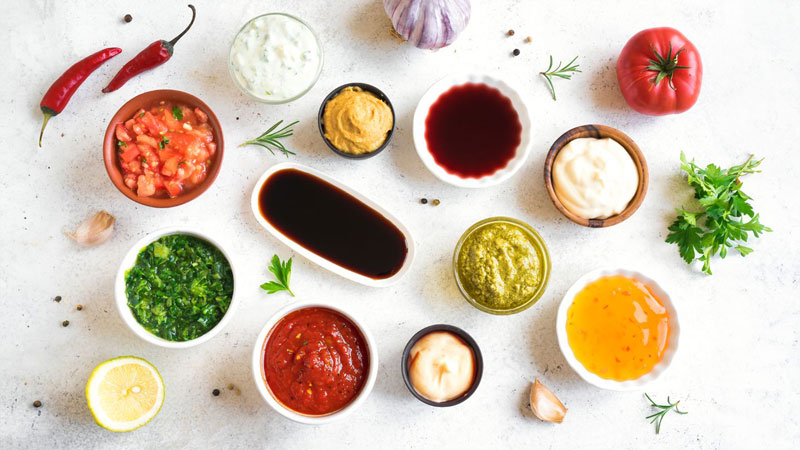
Sauce filling machines are specialized pieces of packaging equipment used to accurately dose and fill sauce into containers such as bottles, jars, pouches, sachets and stick pack. In contrast to standard liquid filling machines designed only to manage thin textures such as water-like liquid fills, they can handle thicker textures with higher viscosities such as chili seeds garlic pieces vegetable bits etc.
At its heart, sauce filling machines focus on volumetric or weight-based filling to guarantee accurate filling - something which the core concept behind sauce filling machines encapsulates.
* Accurate portion control
* minimal product waste
* Stable and repeatable filling results
Depending on the characteristics and format of the sauce packaging, various filling systems, such as piston filling, gear pump filling, rotor pump filling, or even servo-driven filling, may be utilised.
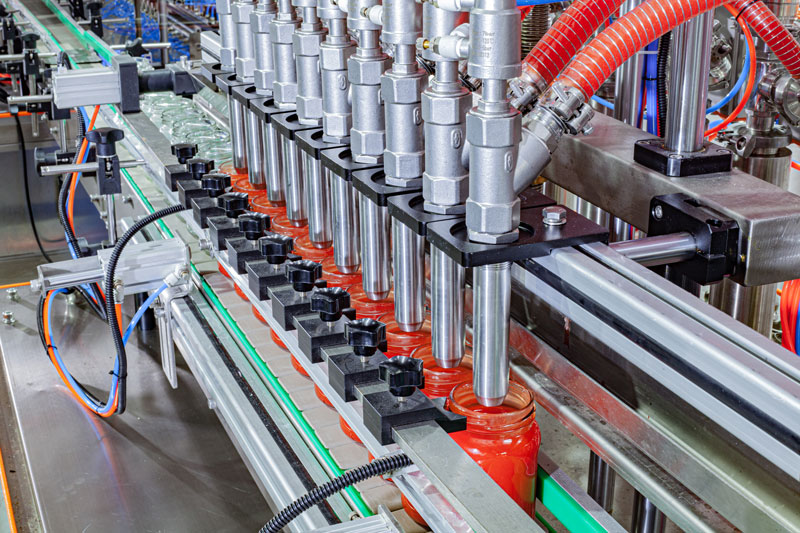
Rising Demand for Processed and Ready-to-Use Sauces
Global consumers increasingly opt for convenience food products. This trend has driven exponential expansion in sauce production, prompting manufacturers to move from manual filling systems to more automated filling solutions.
Improve Fill Accuracy and Consistency
Manual filling often results in inconsistent volumes, product spillage and quality complaints; sauce filling machines employ precision control systems to maintain uniform fill levels thereby helping brands meet professional packaging standards.
Increased Production Efficiency
Automated sauce filling machines offer continuous high speed operation to significantly boost production while decreasing labor requirements in medium to large-scale factories.
Enhance Food Safety and Hygiene Standards
Modern sauce filling machines are constructed from food-grade stainless steel (SUS304 or SUS316) that conforms with international hygiene standards, thus decreasing contamination risks while simultaneously increasing food safety. Closed filling systems help mitigate these concerns further and increase overall food safety.
Compatibility with Multiple Packaging Types
Sauce filling machines allow manufacturers to quickly meet changing market demands by accommodating bottles, jars, pouches, sachets and stick pack within flexible packaging lines. They enable manufacturers to respond more rapidly when demand fluctuates rapidly.
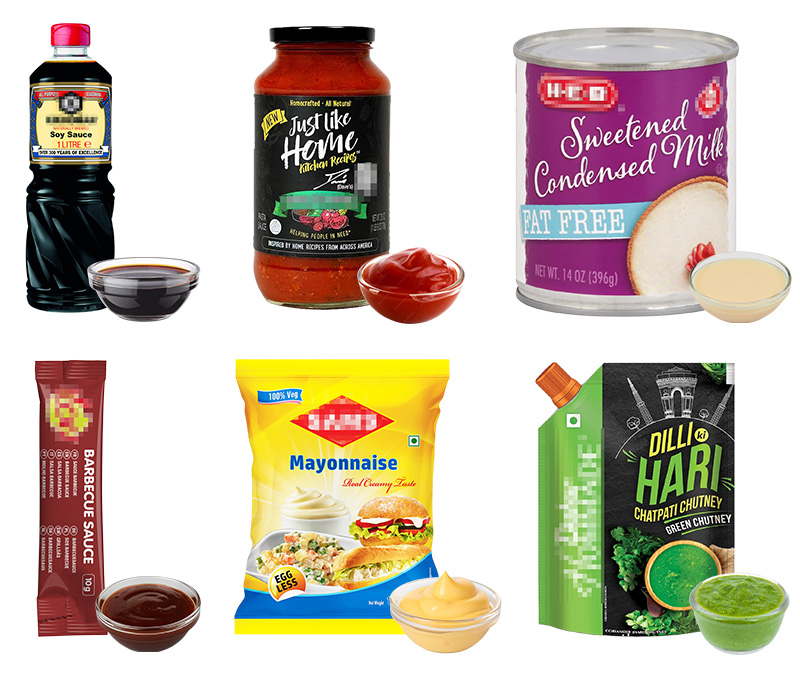
While designs of sauce filling machines vary, their operating principle generally follows an organized approach:
Product Feeding: The sauce is transferred from its storage tank into the filling system using pumps such as: Gear pumps, rotary pumps and pneumatic or servo-driven piston systems
Measuring and Dosing: Measuring and dosing machines measure the exact volume or weight required of each container; servo-controlled systems offer greater accuracy with quicker adjustments.
Filling Process: Our filling nozzles use anti-drip and anti-foaming designs to efficiently dispense sauce into containers for filling without splashing, stringing or other issues.
Container Handling: Containers can be handled automatically depending on their line configuration - moving along, being conveyed to their destinations, filled and discharged at each station in succession.
Integrate With Downstream Equipment: Filling machines for sauce are often integrated with capping, sealing, labeling and cartoning machines to form an efficient packaging line.
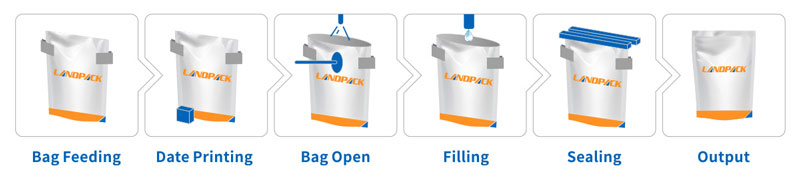
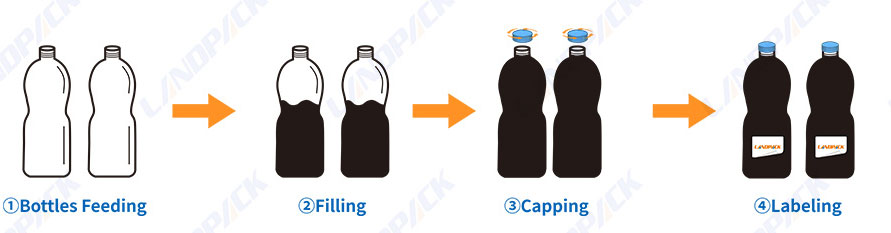
Selecting an effective sauce filling machine requires careful consideration and evaluation. Here is a step-by-step guide designed to assist buyers with making informed decisions.
Step One: Assess Your Sauce Characteristics
Consider viscosity, temperature and whether or not there are particles present when selecting an ideal filling system.
Step Two: Determine Packaging Type and Volume Range
Determine whether you will be filling bottles, jars, pouches stick pack and sachets and determine your filling range (e.g. 10-50 ml; 100-500 ml or 1-5 kg).
Step Three: Determination of Production Capacity
Select a machine with the output per hour that meets your current and anticipated future expansion needs.
Step Four: Select an Automation Level
Your options for packaging lines could include semi-automated, fully automated or complete systems depending on your budget and labor availability.
Step Five: Consider Cleaning and Maintenance needs
CIP (Clean-in-Place) systems with tool-free disassembly save time and reduce downtime for machines.
Step 6: Verify Compliance and Certifications
Be certain the machine complies with food safety standards required by your target markets, such as CE certification.
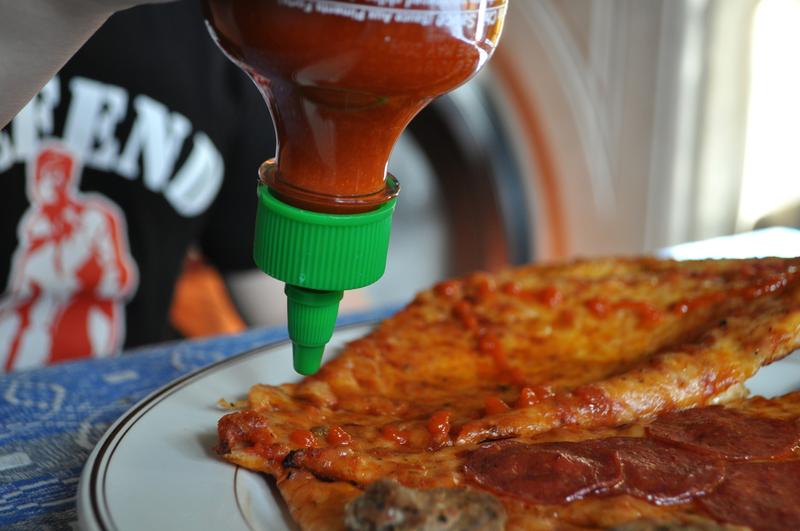
Finding the ideal sauce filling machine depends heavily on factors like packaging format, production capacity and market positioning. Below are several of the most widely-used solutions used for sauce filling in modern food manufacturing environments that are tailored specifically to meet different production needs.
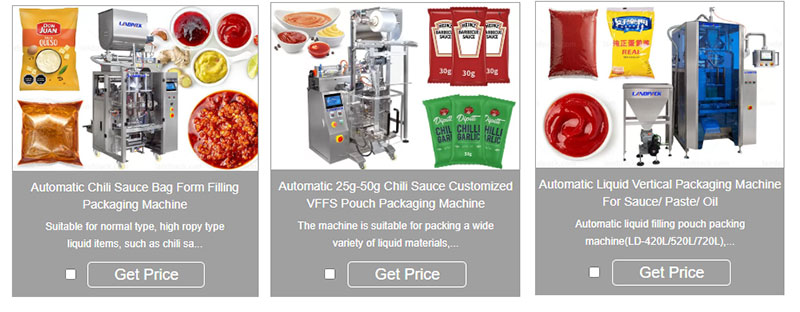
Vertical Packing Machines (VFFSs) are commonly used for filling sauce into sachets, pillow bags or small pouch. This type of sauce packing machine forms bags from roll film, fills the contents vertically before sealing it automatically.
Vertical packing machines are an excellent solution for medium to high viscosity sauces such as ketchup, tomato sauce, chili sauce and seasoning sauces. Equipped with either a piston pump or servo-driven pump, vertical packing machines ensure accurate filling even for thicker sauces.
Key advantages:
1. Compact structure and optimal cost performance
2. Compatible for single serve and retail sachet packaging
3. Stable operation for continuous production
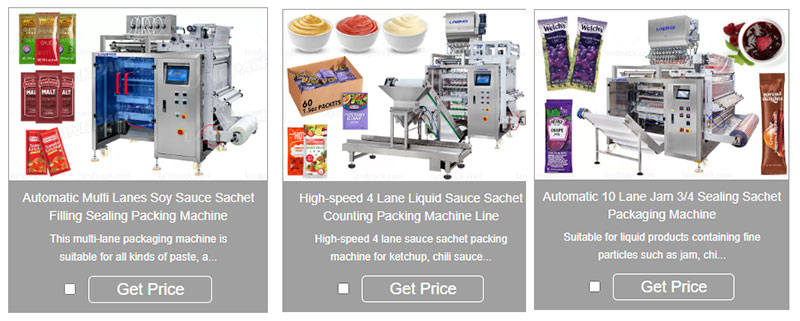
Multi Lane Packing Machines are specifically designed for high-output production of small sauce sachets or stick packs, significantly increasing production capacity without taking up additional floor space. By operating multiple lanes simultaneously, this filling equipment significantly expands capacity
Multi-lane packing machines are frequently utilized to produce ketchup sachets, chili sauce packets, salad dressing portions and instant food seasoning sauces.
Key advantages:
1. High Production Efficiency
2. Consistent sachet sizes and filling accuracy
3. Ideal for high-volume orders and mass distribution.
4. Supports automatic cartoning and secondary packaging
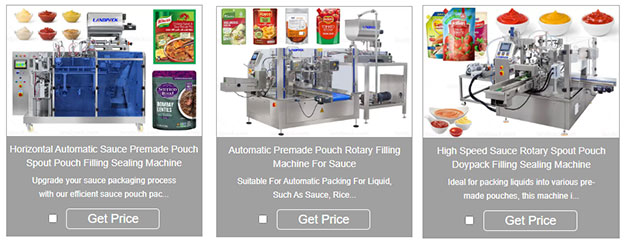
Doypack Machine(Horizontal or Rotary)
Doypack machines come in both horizontal and rotary configurations and are specifically designed to fill sauces into stand-up pouches, spouted pouches and zipper pouches - packaging formats that have become increasingly popular due to their convenience, shelf appeal and reduced material usage.
Doypack sauce packing machines are perfect for filling both smooth and chunky sauces, and can come equipped with either rotor pumps or piston filling systems to handle high viscosity products.
Key advantages:
1. Supports spout filling, zipper opening and pouch sealing.
2. High degree of flexibility when selecting pouch sizes and designs.
3. Hygienic and clean filling performance.
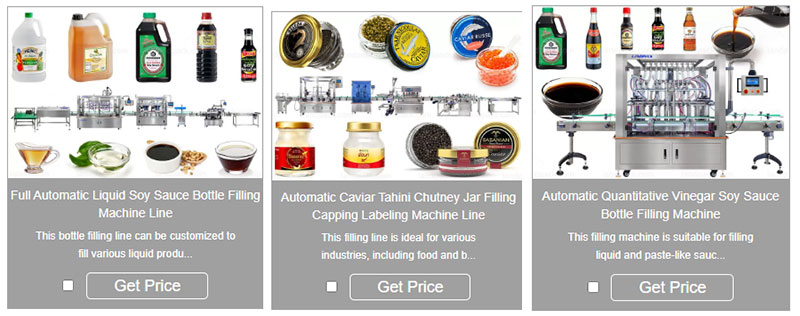
Bottle /Tin/ Can/ Jar Filling Machine
Bottle, Tin, Can or Jar Filling Machines have long been used as the preferred solution for sauce packaging. Ideally suited for glass bottles, PET bottles, metal cans, tins and jars alike, these machines provide precise filling with minimal spillover during filling processes.
Based on your sauce's characteristics, the machine may feature piston filling, gear pump filling or rotor pump filling systems to ensure accurate dosing and clean filling.
Key Advantages:
1. Wrought Iron Containers offer strong compatibility for use.
2. High filling accuracy and consistent performance.
3. Simplify integration with capping, sealing and labeling machines
4. Ideal for use in small to large-scale production environments
Many Years of Manufacturing Experience
Landpack has specialized in packaging and filling machinery, serving customers across food, beverage and daily chemical industries.
Customized Solutions
We provide customized sauce filling solutions based on product characteristics, packaging formats, and production capacity.
High-Quality Components
Landpack machines utilize international-brand electrical and pneumatic components to ensure long-term stability and reliability.
Strict Quality Control Measures are in Place
Each machine goes through stringent testing prior to being delivered, including filling accuracy trials and continuous operation trials.
Global Service and Support
Landpack provides responsive service worldwide to its customers - from installation assistance and after-sale technical support, through installation guidance to aftersales technical support.

1. Can one sauce filling machine handle different types of sauces?
Yes, with proper configuration and adjusted parameters, one machine can fill different viscosity range sauces successfully.
2. Are sauce filling machines suitable for filling particle-containing sauces?
Yes, rotor pump and piston filling systems have been specifically developed to handle particle-filled sauces.
3. How accurate is a sauce filling machine?
Modern, servo-driven machines usually achieve filling accuracy within +-1%.
4. Does cleanup after sauce filling present any difficulties?
Not at all; most machines are designed for simple disassembly and CIP cleaning to minimize downtime and increase productivity.
5. Can Landpack sauce filling machines be seamlessly integrated into an existing production line?
Yes. Landpack sauce filling machines have been specifically designed for seamless integration with upstream and downstream equipment.
An effective sauce filling machine is more than just equipment - it plays a critical role in driving efficiency, consistency and product quality in modern food production. By understanding their sauce characteristics, packaging requirements and production goals manufacturers can find an optimal filling solution to ensure long-term success in their business.
Landpack sauce filling machines offer businesses proven expertise, customized solutions and reliable performance - helping businesses increase production while cutting costs and competing effectively in global markets.Contact us for details.


Copyright © Foshan Land Packaging Machinery Co., Ltd. All Rights Reserved | Sitemap